Awesome Network Analysis


An awesome list
of resources to construct, analyze and visualize network data.
Inspired by Awesome
Deep Learning, Awesome Math and
others. Started in 2016, and irregularly updated since then.
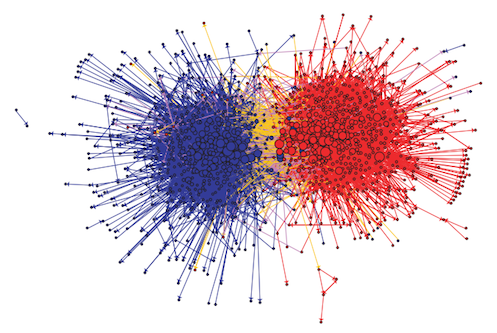
Network of U.S. political blogs by Adamic and
Glance (2004) (preprint).
Note: searching for ‘@’ will return all Twitter
accounts listed on this page.
Contents
Books
Classics
Dissemination
Accessible introductions aimed at non-technical audiences.
General Overviews
- A
First Course in Network Science, by Filippo Menczer, Santo
Fortunato, and Clayton A. Davis - Tutorials, datasets and other resouces
on
GitHub (2020).
- Encyclopedia of
Social Networks, edited by George A. Barnett - Covers all sorts
of network-related themes (many of them not formal) as well as social
network analysis (2011).
- Encyclopedia of
Social Network Analysis and Mining, edited by Reda Alhajj and
Jon Rokne (2014).
- L’analyse de réseau
en sciences sociales. Petit guide pratique, by Laurent
Beauguitte, in French (2023). Readable
online.
- Network
Science, by Albert-László Barabási - Full book online
(2016).
- Network
Science, by the U.S. National Research Council - Full book
online (2005).
- Network
Science: Theory and Practice, by Ted G. Lewis (2011).
- Networks.
An Introduction, by Mark E.J. Newman (2010).
- Networks,
Crowds, and Markets: Reasoning About a Highly Connected World,
by David Easley and Jon Kleinberg - Full pre-publication draft (review;
2010).
- Réseaux
sociaux et structures relationnelles, by Emmanuel Lazega, in
French (2014).
- The
SAGE Handbook of Social Network Analysis, edited by John Scott
and Peter J. Carrington (2011).
- Sociologie
des réseaux sociaux, by Pierre Mercklé, in French (2011).
- Social
and Economic Networks, by Matthew O. Jackson (2008).
- Social
Network Analysis with Applications, by Ian McCulloh, Helen
Armstrong and Anthony Johnson (2013).
- Social Networks:
An Introduction, by Jeroen Bruggeman (related material;
2008).
- Studying
Social Networks. A Guide to Empirical Research, by Marina
Hennig et al. (2013).
- Understanding
Social Networks. Theories, Concepts, and Findings, by Charles
Kadushin (2012).
Graph Theory
- Combinatorics and
Graph Theory, by John Harris, Jeffry L. Hirst and Michael
Mossinghoff (2008).
- The
Fascinating World of Graph Theory, by Arthur Benjamin, Gary
Chartrand and Ping Zhang (2015).
- Graph
Theory, by John A. Bondy and Uppaluri S.R. Murty (2008).
- Graph
Theory, by Reinhard Diestel - Full book online, also in Chinese
and German (2016).
- Graph
Theory, by Frank Harary - Full book online (1969).
- Graphs
& Digraphs, by Gary Chartrand, Linda Lesniak and Ping Zhang
(2016).
- Introduction
to Combinatorics and Graph Theory, by David Guichard - Full
book online (2016).
- Modern
Graph Theory, by Belá Bollobás (1998).
Method-specific
- Bayesian Networks
in R with Applications in Systems Biology, by Radhakrishnan
Nagarajan, Marco Scutari and Sophie Lèbre (website; 2013).
- Bayesian
Networks with Examples in R, by Marco Scutari and Jean-Baptiste
Denis (website;
2014).
- The
Book of Trees. Visualizing Branches of Knowledge, by Manuel
Lima - Hundreds of beautiful tree diagrams, from all periods of history
(2014).
- Exponential
Random Graph Models for Social Networks, edited by Dean Lusher,
Johan Koskinen and Garry Robins (2013).
- Generalized
Blockmodeling. Structural Analysis in the Social Sciences, by
Patrick Doreian, Vladimir Batagelj and Anuška Ferligoj (2004).
- Handbook
of Graph Drawing and Visualization, edited by Roberto Tamassia
(chapter proofs;
2013).
- Handbuch
Historische Netzwerkforschung. Grundlagen und Anwendungen,
edited by Marten Düring et al., in German (2016).
- An
Introduction to Exponential Random Graph Modeling, by Jenine K.
Harris (2014).
- Knoten
und Kanten. Soziale Netzwerkanalyse in Wirtschafts- und
Migrationsforschung, edited by Markus Gamper and Linda Reschke,
in German (2010).
- Knoten
und Kanten 2.0. Soziale Netzwerkanalyse in Medienforschung und
Kulturanthropologie, edited by Markus Gamper, Linda Reschke and
Michael Schönhuth, in German (2012).
- Knoten und Kanten III. Soziale Netzwerkanalyse in
Geschichts- und Politikforschung, edited by Markus Gamper,
Linda Reschke and Marten Düring, in German and English (2015).
- Inferential
Network Analysis, by Skyler J. Cranmer, Bruce A. Desmarais and
Jason Morgan (2020).
- Multilayer Social
Networks, by Mark E. Dickison, Matteo Magnani and Luca Rossi
(2016).
- Multilevel Network
Analysis for the Social Sciences, edited by Emmanuel Lazega and
Tom A.B. Snijders (2016).
- Multimodal
Political Networks, by David Knoke, Mario Diani, James Hollway
and Dimitri Christopulos (2021).
- Multivariate
Network Visualization, edited by Andreas Kerren, Helen C.
Purchase and Matthew O. Ward (2014).
- Network
Analysis in Archaeology, edited by Carl Knappett (2013; review in French).
- Network
Analysis: Methodological Foundations, edited by Ulrik Brandes
and Thomas Erlebach - Covers network centrality, clustering,
blockmodels, spatial networks and more (2005).
- Political
Networks. The Structural Perspective, by David Knoke
(1994).
- Social
Network Analysis for Ego-Nets: Social Network Analysis for Actor-Centred
Networks, by Nick Crossley et al. (2015).
- Understanding
Large Temporal Networks and Spatial Networks, by Vladimir
Batagelj et al. (2014).
Software-specific
- Algorithmic Graph
Theory and Sage, by David Joyner, Minh Van Nguyen, and David
Phillips - Full book online (2013).
- Analyzing
Social Networks (using UCINET), by Stephen P. Borgatti, Martin
G. Everett and Jeffrey C. Johnson (2013).
- A
User’s Guide to Network Analysis in R, by Douglas A. Luke
(2015).
- Data
Science and Complex Networks: Real Case Studies with Python, by
Guido Caldarelli and Alessandro Chessa (2016).
- Exploratory
Social Network Analysis with Pajek, by Wouter de Nooy, Andrej
Mrvar and Vladimir Batagelj (2011; also in
Japanese and in
Chinese).
- Gephi
Cookbook (2015).
- Graph
Drawing Software (covering many programs), edited by Michael
Jünger and Petra Mutzel (2004).
- Introduction
to Social Network Methods (using mostly UCINET), by Robert A.
Hanneman and Mark Riddle - Full book online (2001).
- Mastering
Gephi Network Visualization, by Ken Cherven (2015).
- Network Analysis with R/igraph, by Gabor Csárdi, Thomas
Nepusz and Eduardo M. Airoldi (in preparation).
- Network Analysis with Python/igraph, by Thomas Nepusz,
Gabor Csárdi and Eduardo M. Airoldi (in preparation).
- Network
Graph Analysis and Visualization with Gephi, by Ken Cherven
(2013).
- Social Network
Analysis for Startups. Finding Connections on the Social Web
(using Python), by Maksim Tsvetovat and Alexander Kouznetsov (code; 2011).
- Statistical
Analysis of Network Data with R, by Eric D. Kolaczyk and Gabor
Csárdi (R package;
2014).
Topic-specific
- Communities
and Networks: Using Social Network Analysis to Rethink Urban and
Community Studies, by Katherine Giuffre (2013).
- Comparing
Policy Networks. Labor Politics in the U.S., Germany, and
Japan, by David Knoke et al. (1996).
- Conducting
Personal Network Research: A Practical Guide, by Christopher
McCarty et al. (2019).
- The
Connected Past. Challenges to Network Studies in Archaeology and
History edited by Tom Brughmans, Anna Collar and Fiona Coward
(2016; companion website).
- The Development of Social
Network Analysis: A Study in the Sociology of Science, by
Linton C. Freeman, in English and several other languages (2004; follow-up paper, 2011).
- Dynamical
Networks in Psychology: More Than A Pretty Picture?, by Laura
Bringmann (2016; PhD dissertation).
- Dynamical
Processes on Complex Networks, by Alain Barrat, Marc Barthélemy
and Alessandro Vespignani (2008).
- Economic Networks:
Theory and Computation, by John Stachurski and Thomas J.
Sargent (2022).
- Fundamentals
of Brain Network Analysis, by Alex Fornito, Andrew Zalesky and
Edward Bullmore (2016).
- Inside
Criminal Networks, by Carlo Morselli (2009).
- Neighbor
Networks. Competitive Advantage Local and Personal, by Ronald
S. Burt (2010).
- Network
Analysis Literacy. A Practical Approach to the Analysis of
Networks, by Katharina A. Zweig (2016).
- Networks
in Social Policy Problems, edited by Balázs Vedres and Marco
Scotti (2012).
- The
Oxford Handbook of the Economics of Networks, edited by Yann
Bramoullé, Andrea Galeotti and Brian Rogers (2016).
- Policy
Debates as Dynamic Networks: German Pension Politics and Privatization
Discourse, by Philip Leifeld (2016).
- Small
Worlds: The Dynamics of Networks between Order and Randomness,
by Duncan J. Watts (2003).
- Theories
of Communication Networks, by Peter Monge and Nosh Contractor
(2003).
- The
Chessboard and the Web. Strategies of Connection in a Networked
World, by Anne-Marie Slaughter (2017); applies network science
to world politics.
- Towards
Relational Sociology, by Nick Crossley (2011).
- Die
Verbundenheit der Dinge. Eine Kulturgeschichte der Netze und Netzwerke
[The Connectedness of Things. A Cultural History of Nets and
Networks], by Sebastian Gießmann, in German (2014).
- Verdeckte
soziale Netzwerke im Nationalsozialismus. Die Entstehung und
Arbeitsweise von Berliner Hilfsnetzwerken für verfolgte Juden [Hidden
Social Networks in National Socialism: The origins and working methods
of Berlin assistance networks for persecuted Jews], by Marten
Düring, in German (2015; related
publications and video presentation in
English).
- Visualisierung
komplexer Strukturen. Grundlagen der Darstellung mehrdimensionaler
Netzwerke, by Lothar Krempel, in German.
Conferences
Recurring conferences on network analysis.
Courses
- Complex
Networks, by Rémy Cazabet (University Lyon 1 and ENS Lyon, 2022).
- Complex
Networks, by Peter Sheridan Dodds (University of Vermont, 2016;
Twitter: @networksvox).
- Graph
Theory and Applications, by Paul Van Dooren - Full lecture slides
(Hamilton Institute, Dublin, 2009).
- Graph
Theory (Mathematics), by Christopher Griffin - Full lecture notes
(Penn State University, 2012).
- Graphs
and Networks, by Dan Spielman (Yale University, 2013).
- Network
Analysis and Modeling (Computer Science), by Aaron Clauset - Full
lecture slides and readings (University of Colorado, 2022).
- Networks,
Complexity and Its Applications (Media Arts and Sciences), by Cesar
Hidalgo (MIT, 2011).
- Networks,
Crowds and Markets, by David Easley, Jon Kleinberg and Eva Tardos
(presentation;
Cornell University via edX, 2016).
- Networks
(Economics), by Mardavij Roozbehani and Evan Sadler (MIT, 2018).
- Network
Science (Computer Science), by Constantine Dovrolis - Mostly open
access readings (Georgia Tech, 2015).
- Political
Networks: Methods and Applications, by Zeev Maoz (University of
California in Davis, 2012).
- Social and
Economic Networks: Models and Analysis, by Matthew O. Jackson
(Stanford University via Coursera, 2015).
- Social Network
Analysis, by Lada Adamic (University of Michigan via Coursera, not
yet run).
- Social
Network Analysis and Intermediate
Social Network Theory, by Matthew J. Denny - Workshop notes and
slides (2014–5).
- Social Network
Analysis with Pajek, by Andrej Mrvar (University of Ljubljana,
2016).
- Social
Networks, by Dennis M. Feehan (University of Berkeley, 2017).
- The
Structure of Information Networks, by Jon Kleinberg - Links to many
diverse readings (Cornell University, 2008).
Datasets
- Animal Social Network
Repository - Large “multi-species
repository of social networks.”
- Bayesian Network
Repository.
- Bill Cosponsorship
Networks in European Parliaments - Legislative cosponsorship
networks, in R format.
- Colorado Index of Complex
Networks (ICON) - Large collection of networks described and indexed
by Aaron Clauset’s research group.
- Connectome
- Comprehensive maps of neural connections.
- Enron Email
Dataset.
- Eric D.
Kolaczyk’s Network Datasets.
- Gephi
Datasets.
- Hetionet: an integrative
network of disease - A complex biological network, available in
multiple formats, including JSON and Neo4j.
- igraphdata - R
data-centric package.
- Interaction Web
Database - Ecological species interactions.
- International
Currencies 1890-1910 - Historical data on the international
connections between 45 currencies.
- KONECT - The Koblenz Network
Collection - Includes, among other things, networks of collaboration
in DBpedia and Wikipedia, GitHub (companion handbook).
- Linton Freeman’s
Network Data - Over 300 datasets of all sorts, in UCINET
format.
- Mangal - Online platform to analyze,
archive and share ecological network data (preprint, Python package, R package).
- Manlio De Domenico’s
Complex Multilayer Networks.
- Mark E.J.
Newman’s Network Data (example
visualizations).
- Network Repository -
Fully searchable database containing hundreds of real-world
networks.
- Network
Science Book - Network Datasets - Network data sets from
Albert-László Barabási’s Network Science book. Includes data on
IMDB actors, arXiv scientific collaboration, network of routers, the US
power grid, protein-protein interactions, cell phone users, citation
networks, metabolic reactions, e-mail networks, and nd.edu Web pages.
- Norwegian
Interlocking Directorate, 2002-2011 - Two-mode and one-mode data on
gender representation in Norwegian firms.
- Movie galaxies - A database
of movie characters interaction graphs.
- Pajek
Datasets.
- Philosophers
Networks from Randall Collins’s The Sociology of
Philosophies.
- Siena
Datasets.
- SocioPatterns
Datasets - Network data obtained through the SocioPatterns sensing
platform.
- Stanford Large
Network Dataset Collection.
- State
Networks - US state-to-state relational variables, including
borders, travel, trade and more.
- tnet Datasets -
Weighted network data.
- UC
Berkeley Social Networks Study (UCNets) - Ego-centric data (personal
networks) from a five-year panel study.
- UCI Network Data
Repository.
- UCINET
Datasets - Network data in UCINET format.
Journals
Journals that are not fully open-access are marked as “gated”. Please
also note that some of the publishers listed below are deeply hurting scientific
publishing.
- Applied Network
Science (Springer Open).
- ARCS – Analyse de réseaux
pour les sciences sociales / Network Analysis for the Social
Sciences, in English and in French (GDR ARSHS).
- Computational
and Mathematical Organization Theory (Springer, gated).
- Computational
Social Networks (Springer Open).
- Connections
(INSNA). Twitter: @ConnectionsSNA.
- IEEE
Transactions on Network Science and Engineering (IEEE).
- Journal of Complex
Networks (Oxford, gated).
- The Journal of
Mathematical Sociology (Taylor & Francis, gated).
- Journal
of Social Structure (INSNA). Older archives.
- NETCOM.
Networks and Communication Studies, in English and in French
(Revues.org).
- Network
Science (Cambridge, gated).
- Online
Social Networks and Media (Elsevier, gated).
- REDES. Revista
hispana para el análisis de redes sociales, in Spanish
(INSNA).
- Social Network
Analysis and Mining (Springer, gated).
- Social
Networks (Elsevier, gated).
Professional Groups
Research Groups (USA)
Network-focused research centers, (reading) groups, institutes, labs
– you name it – based in the USA.
Research Groups (Other)
Network-focused research centers, (reading) groups, institutes, labs
– you name it – based outside of the USA.
- Cambridge Networks Network
(CNN) - Research network on complex networks.
- Centre
for Business Network Analysis, University of Greenwich - Focused on
economic/organisational network analysis.
- Center for Network Science, Central
European University, Budapest - Features a PhD in Network Science
program.
- Complex Networks -
Research group based in Paris.
- Cx-Nets - Virtual collaboration
between four complex networks research groups.
- Data Science Group -
Wroclaw-based research group that studies, among many things, complex
networks and other network-related topics.
- Digital Humanities -
Interdisciplinary group of researchers at the Marc Bloch Centre in
Berlin, with many network science projects.
- Forschungscluster der
Universitäten Trier und Mainz “Gesellschaftliche Abhängigkeiten und
soziale Netzwerke”, in German.
- GDR Analyse de réseaux en
sciences humaines et sociales – French research group with funds to
support training and workshops on network analysis for social
scientists.
- Historical Network
Research (HNR) - Platform for scholars interested in network
analysis for historical research.
- ANR-Lab - International Laboratory
for Applied Network Research - Russian group based at the National
Research University in Moscow.
- Large Graphs and
Networks - Research group at the Catholic University of Louvain (official
page).
- MelNet
Social Network Research Group, Swinburne University of Technology.
Twitter: @melnetsna.
- Mitchell
Centre for Social Network Analysis, University of Manchester -
Currently studies covert
networks. Twitter: @MitchellSNA.
- Murata Laboratory -
Tokyo-based research group, studying bi-, tri- and k-partite
(hyper)networks.
- NetLab
- Research network at the University of Toronto, led by Barry
Wellman.
- Network
Science Research Centre, Swansea University.
- Network Dynamics -
Research Lab at McGill University, led by Derek Ruths
- Netzwerkerei - Historical
research project on the connections between Jewish intellectuals.
- ORIO
- Observatoire des Réseaux Intra- et Inter-Organisationnels - A
research program on networks and regulation.
- Redes-Sociales, in
Spanish - Information network based at the Universitat Autònoma de
Barcelona.
- RES-HIST : Réseaux et
histoire, in French - Blog posts from a research group on historical
networks.
- SocioPatterns -
Interdisciplinary research group that uses wireless sensors to study
social network data.
- SoNAR-C - Social
Network Analysis Research Center, University of Italian Switzerland
(USi).
- Topographies
of Entanglements. Mapping Medieval Networks - Research platform
based at the Austrian Academy of Sciences that focuses on applying
network theory and visualisation to medieval history.
- UCL Centre for Organisational
Network Analysis (CONA).
- Virtual Observatory for the Study of
Online Networks (VOSON) - Research and software development project
located at the Australian National University.
Review Articles
Archeological and
Historical Networks
See also the bibliographies by
Claire Lemercier and Claire Zalc (section on ‘études
structurales’), by
the Historical Network Research Group, and by
Tom Brughmans.
- Analyse de réseaux
et histoire, in French (Revue d’histoire moderne et
contemporaine, 2005).
- Analyser les réseaux du
passé en archéologie et en histoire, in French (Les Nouvelles de
l’Archéologie, 2014).
- Formale
Methoden der Netzwerkanalyse in den Geschichtswissenschaften: Warum und
Wie? [Formal Network Methods in History: Why and How?], in German
(preprint in
English; Österreichische Zeitschrift für
Geschichtswissenschaften, 2012).
- From
Hermeneutics to Data to Networks: Data Extraction and Network
Visualization of Historical Sources (Programming Historian,
2015).
- Graph Theory and
Networks in Biology (preprint; IET Systems
Biology, 2007).
- Introduction
à la visualisation de données : l’analyse de réseau en histoire, in
French (Geschichte und Informatik, 2015).
- Introduction : où en
est l’analyse de réseaux en histoire ? [Introducción: ¿en qué punto se
encuentra el análisis de redes en Historia?], in French and Spanish
(REDES, 2011).
- Networks and
History (Complexity, 2002).
- Networks in
Historical Research (in The Historian’s Macroscope,
2013).
- Networks of
Power in Archaeology (Annual Review of Anthropology,
2014).
- Netzwerkanalyse
in den Geschichtswissenschaften. Historische Netzwerkanalyse als Methode
für die Erforschung von historischen Prozessen, in German (Prozesse. Formen,
Dynamiken, Erklärungen, 2015).
- The
Roots and Shoots of Archaeological Network Analysis: A Citation Analysis
and Review of the Archaeological Use of Formal Network Methods
(Archaeological Review from Cambridge, 2014).
- Thinking Through
Networks: A Review of Formal Network Methods in Archaeology
(Journal of Archaeological Method and Theory, 2013).
Bibliographic,
Citation and Semantic Networks
- Assessing Impact
and Quality from Local Dynamics of Citation Networks (Journal of
Informetrics, 2012).
- Atypical
Combinations and Scientific Impact (Science, 2013).
- On Bibliographic
Networks (Scientometrics, 2013).
- Dynamic
Scientific Co-Authorship Networks (Models of Science
Dynamics, 2012).
- Extracting
Citation Networks from Publications in Classics (Digital
Humanities Quarterly, 2016).
- Self-Citations,
Co-Authorships and Keywords: A New Approach to Scientists’ Field
Mobility? (Scientometrics, 2007).
- Socio-Semantic
Frameworks (preprint;
Advances in Complex Systems, 2013).
- Socio-Semantic Modeling
of Epistemic Communities (APSA, 2014).
- Tradition and
Innovation in Scientists’ Research Strategies (Annual Review of
Sociology, 2015).
Biological,
Ecological and Disease Networks
Complex and Multilayer
Networks
Ethics of Network Analysis
Network Modeling
- A
Brief History of Statistical Models for Network Analysis and Open
Challenges (Journal of Computational and Graphical
Statistics, 2012).
- Basic
Models and Questions in Statistical Network Analysis (Statistics
Surveys, 2017).
- Introduction
to Stochastic Actor-Based Models for Network Dynamics (preprint;
Social Networks, 2010).
- Navigating the Range of
Statistical Tools for Inferential Network Analysis (American
Journal of Political Science, 2017).
- Positional
Analysis and Blockmodeling
(Computational
Complexity, 2012).
- Social Network Evolution
and Actor Oriented Models (Mathematics & Social
Sciences, 1997).
- Statistical
Models for Social Networks (Annual Review of Sociology,
2011).
- A Survey of
Statistical Network Models - Book-length review (preprint; Foundations and
Trends in Machine Learning, 2010).
- A Unified View of
Generative Models for Networks: Models, Methods, Opportunities, and
Challenges (video
presentation; NIPS 2014
workshop on “Networks:
From Graphs to Rich Data”).
Network Visualization
Social, Economic and
Political Networks
See also the bibliographies by Eszter Hargittai,
by
Pierre François and by
Pierre Mercklé.
- A propos de la notion de
rôle dans l’analyse des relations sociales (Mathématiques et
sciences humaines, 2011).
- Brokerage
(Annual Review of Sociology, 2012).
- Birds of a
Feather: Homophily in Social Networks (Annual Review of
Sociology, 2001).
- Mixed-Method Approaches to
Social Network Analysis (ESRC NCRM Discussion Paper, 2010).
- Network
Analysis and Political Science (Annual Review of Political
Science, 2011).
- Network
Analysis for International Relations (International
Organization, 2009).
- Network
Analysis in the Social Sciences (Science, 2009).
- Networks
and Trade (Annual Review of Economics, 2018).
- Networks
in Social Psychology, Beginning with Kurt Lewin
(Encyclopedia of
Social Network Analysis and Mining, 2014).
- Networks in
the Understanding of Economic Behaviors (Journal of Economic
Perspectives, 2014).
- Positions
and Roles
(The SAGE Handbook of
Social Network Analysis, 2011).
- The
Social and the Sexual: Networks in Contemporary Demographic Research
(PSC Working Paper Series, 2013).
- Social
Network Analysis in the Study of Terrorism and Political Violence
(preprint;
PS: Political Science and Politics, 2011).
- Social
Networks and Crime: Pitfalls and Promises for Advancing the Field
(Annual Review of Criminology, 2019).
- Urban Social Networks: Some Methodological Problems and
Possibilities (The
Small World, 1989).
Selected Papers
A voluntarily short list of applied, epistemological and
methodological articles, many of which have become classic readings in
network analysis courses. Intended for highly motivated social science
students with little to no prior exposure to network analysis.
- Aux
sources des grands réseaux d’interactions. Retour sur quelques
propriétés déterminantes des réseaux sociaux issus de corpus
documentaires, by Pascal Cristofoli, in French - Reviews the current
state of relational sociology and network analysis in light of the
large-scale and online data (Réseaux, 2008).
- Birds of a
Feather, Or Friend of a Friend? Using Exponential Random Graph Models to
Investigate Adolescent Social Networks, by Steven M. Goodreau, James
A. Kitts and Martina Morris - Accessible introduction to the logic and
application of exponential random graph modeling (Demography,
2001).
- Chains of
Affection: The Structure of Adolescent Romantic and Sexual Networks,
by Peter S. Bearman, James Moody and Katherine Stovel - Classic example
of topological network analysis applied to a network of affective and
sexual ties (American Journal of Sociology, 2004).
- Coauthorship
and Citation Patterns in the Physical Review, by Travis
Martin et al. - Highly typical study of scientific publishing
productivity and collaboration through temporal network analysis (preprint; Physical Review
E, 2013).
- The
Convergence of Social and Technological Networks, by Jon Kleinberg -
Discusses small-world effects and social contagion within the context of
the Internet and social media (Communications of the ACM,
2008).
- Deux
traditions d’analyse des reseaux sociaux, by Michael Eve (English
version; Réseaux, 2002).
- Homophily
and Contagion Are Generically Confounded in Observational Social Network
Studies, by Cosma R. Shalizi and Andrew C. Thomas - Makes a very
important point for the analysis of network diffusion and influence
(Sociological Methods and Research, 2011).
- La
notion de réseau complexe : du réseau comme abstraction et outil à la
masse de données des réseaux sociaux en ligne, by Alain Barrat, in
French - Accessible introduction to the study of complex networks
(Communication & Organisation, 2013).
- Network
Analysis, Culture, and the Problem of Agency, by Mustafa Emirbayer
and Jeff Goodwin (American Journal of Sociology, 1994), and Manifesto for
a Relational Sociology, by Mustafa Emirbayer (American Journal
of Sociology, 1997) - Sociological foundations for a science of
social ties.
- Network
Theory, Plot Analysis, by Franco Moretti - Example applications of
(fictional) network analysis in literary studies (New Left
Review, 2011).
- Node
Centrality in Weighted Networks: Generalizing Degree and Shortest
Paths, by Tore Opsahl, Filip Agneessens and John Skvoretz - Explores
the generalization of network centrality and distance measures to
(positively) valued graphs (Social Networks, 2010; companion website).
- Scale-Free Networks, by
Albert-László Barabási and Eric Bonabeau - Early, accessible formulation
of the “networks are everywhere” argument (Scientific American,
2003).
- Social
Networks and Causal Inference, by Tyler J. VanderWeele and Weihua An
- Reviews the different ways in which network analysis can produce
meaningful causal statements, as well as the inherent limits of network
analysis for doing so (Handbook
of Causal Analysis for Social Research, 2013).
- The
Performativity of Networks, by Kieran Healy - Network analysis meets
science studies: social networks, like financial markets, are highly
subject to performativity, i.e. the possibility that reality might be
altered by its theoretical inquiry (European Journal of
Sociology, 2015).
- Revisiting the
Foundations of Network Analysis, by Carter T. Butts - On choosing
the right network representation to frame a research problem.
- Robust
Action and the Rise of the Medici, 1400-1434, by John F. Padgett and
Christopher K. Ansell - Classic analysis of power relations in the
Renaissance Florentine state (American Journal of Sociology,
1993).
- The
Strength of Weak Ties, by Mark Granovetter - Arch-classic example of
applying network analysis to a social issue: jobseeking (American
Journal of Sociology, 1973).
- The
Ties that Divide: A Network Analysis of the International Monetary
System, 1890–1910 (The Journal of Economic History, 2005)
and The
Empirics of International Currencies: Network Externalities, History and
Persistence (The Economic Journal, 2009), both by Marc
Flandreau and Clemens Jobst - Network analysis of the foreign exchange
system in the late 19th century (data).
- Topics in Social Network
Analysis and Network Science, by A. James O’Malley and Jukka-Pekka
Onnela - 50-page introduction to network analysis, with just the right
amount of detail on all aspects of it (The Handbook of Health
Services Research, forthcoming 2017).
Software
For a hint of why this section of the list might be useful to some,
see Mark
Round’s Map of Data Formats and Software Tools (2009).
Several links in this section come from the NetWiki Shared
Code page, from the Cambridge Networks Network List of Resources for
Complex Network Analysis, and from the Software for
Social Network Analysis page by Mark Huisman and Marijtje A.J. van
Duijn. For a recent academic review on the subject, see the Social Network
Algorithms and Software entry of the International Encyclopedia
of Social and Behavioral Sciences, 2nd edition (2015).
See also the Social
Network Analysis Project Survey (blog post),
an earlier attempt to chart social network analysis tools that links to
many commercial platforms not included in this list, such as Detective.io. The Wikipedia English
entry on Social
Network Analysis Software also links to many commercial that are
often very expensive, outdated, and far from being awesome by any
reasonable standard.
Software-centric tutorials are listed below their program of choice:
other tutorials are listed in the next
section.
- ArcGIS
Network Analyst - Network-based spatial analysis software for
solving complex routing problems.
- CFinder - Cross-platform Java
program to identify clusters and communities through the Clique
Percolation Method (CPM).
- Circos - Cross-platform program to
produce circular layouts of network data, written in Perl.
- Cytoscape - Cross-platform
Java program to build, analyze and visualize networks. Also a JavaScript
library.
- Discourse
Network Analyzer (DNA) - Qualitative content analysis tool with
network export facilities, written in Java with R integration.
- E-Net -
Windows program for ego network analysis.
- EgoNet -
Cross-platform Java program for ego network analysis.
- EgoWeb -
Server-side software for social network data collection and
processing.
- easyN - Online tool aimed at
representing and sharing gene interaction networks as well as Petri net
models.
- Gephi - Cross-platform, free and
open source tool for network visualization.
- GLEAMviz Simulator -
Cross-platform tool intended for the prediction of human epidemics.
- Graph Commons -
Collaborative platform for mapping, analyzing and publishing
data-networks.
- Graphia - Cross-platform tool to
visualize large and complex networks (announcement).
- Graphviz - Cross-platform
software to draw graphs in the DOT graph drawing language.
- Graphy - Graph theory
library written in Ruby.
- GraphX - Apache Spark module to perform
graph-related parallel computation.
- Linkage - Online tool to visualize
and model networks with textual edges.
- Lynks - Web-based tool for
simple network analysis and visualization.
- Mathematica -
Cross-platform program with graph theory and network analysis
functionalities.
- IGraph/M -
Interface to use the
igraph library from within
Mathematica, using standard Mathematica Graph objects.
- Metamaps - Free, open-source
platform to draw networks, currently in beta.
- MuxViz - Cross-platform, free and
open source tool to study multilayer networks, based on R and GNU
Octave.
- Neo4j - Open source, scalable graph
database, used by companies like Linkurious.
- Network Canvas - A free and
open-source set of survey tools for ego-centric and personal network
studies, including documentation and a
user community.
- Node Overlap and Segregation
Software - Web-based tool to compute Strona and Veech’s
node overlap and segregation measures.
- Nodegoat - Web-based data
management, network analysis and visualisation environment (blog).
- NodeXL - Free, open-source
template to explore network graphs with Microsoft Excel.
- ORA-LITE -
Windows program for dynamic meta-network assessment and analysis.
- OSoMe - Web-based platform
to analyze social media data, including through Twitter-based and
co-occurrence networks.
- Pajek - Windows
program for large network analysis, free for noncommercial use.
- Palladio -
Web-based spatial network visualization tool by the Humanities + Design research lab
at Stanford University.
- PARTNER -
Program to Analyze, Record, and Track Networks to Enhance
Relationships - Excel-based tool for building networks from
surveys.
- PIGALE - Public
Implementation of a Graph Algorithm Library and Editor - Windows
program and C++ library to analyze planar graphs.
- PNet
- Simulation and estimation of (one-mode and multilevel) exponential
random graph models (ERGMs), written in Java for Windows.
- Polinode - Web-based
platform to both analyze network data as well as collect network data
via relationship-based surveys.
- PUCK - Program for the Use and
Computation of Kinship data - Cross-platform Java program for
genealogical network analysis.
- qgis-edge-bundling
- Implementation of force-directed edge bundling for the QGIS Processing
toolbox.
- Radatools -
Set of tools intended for the analysis of complex networks, built on top
of Radalib,
a library written in Ada.
- Retina - Web
application to share GEXF and GraphML network visualizations.
- SageMath - Free open-source
mathematics software with extensive graph
capabilities.
- Segrada - Cross-platform tool
to build and visualize semantic graph databases.
- Siena -
Simulation Investigation for Empirical Network Analysis. Formerly a
Windows program, now developed as the RSiena R package.
- SocNetV - Social Network
Visualizer - Cross-platform program that includes a simple
Web crawler to construct hyperlink networks.
- SoNIA - Social
Network Image Animator - Tool to visualize dynamic or longitudinal
network data. Formerly a Java program (example
movies), now developed as the ndtv R package.
- SparklingGraph -
Cross-platform tool to perform large-scale, distributed network
computations with Apache Spark’s GraphX module; written in Java and
Scala.
- SPaTo Visual Explorer -
Cross-platform program for the visualization and exploration of complex
networks.
- StOCNET -
Several Windows programs developed by the same team as Siena.
- Tulip - Cross-platform network
analysis and visualization framework built on top of a C++ library, with
plugins dedicated to specific biological and physical networks. Also
available through its Python
package.
- UCINET -
Windows commercial software package for the analysis of social network
data.
- Uberlink - Software suite for
online (hyperlink) network analysis, by the VOSON research project.
- UNISoN - Cross-platform
program to download and visualize Usenet data. Developed
for a Masters degree.
- VennMaker: An
Actor-Centered Interactive Network Mapping Tool - Cross-platform
Java program for ego network analysis.
- Visone - Cross-platform Java
network analysis and visualization program, free for noncommercial use.
- Vizster -
Cross-platform Java program to visualize online social networks.
- VOSviewer - Cross-platform
Java tool for constructing and visualizing bibliometric networks.
Algorithms
Network placement and community detection algorithms that do not fit
in any of the next subsections.
See also the Awesome
Algorithms and Awesome
Algorithm Visualization lists for more algorithmic awesomess.
C / C++
For more awesome C / C++ content, see the Awesome C
and Awesome C / C++
lists.
Java
- GraphStore -
In-memory graph structure implementation, powering Gephi.
- GraphStream - Java
library for the modeling and analysis of dynamic graphs.
- Mixer -
Prototype showing how to use Apache
Fluo to continuously merge multiple large graphs into a single
derived one.
JavaScript
For more awesome JavaScript libraries, see the Awesome
JavaScript list.
Julia
MATLAB
See also the webweb tool listed in the Python
section.
Python
Many items below are from a
Google spreadsheet by Michał Bojanowski and others.
See also Social
Network Analysis with Python, a 3-hour tutorial by Maksim Tsvetovat
and Alex Kouznetsov given at PyCon US 2012 (code).
For more awesome Python packages, see the Awesome Python and Awesome Python
Books lists.
- bokeh - Python library for
interactive data visualization in the browser, with support for
networks.
- cdlib - Python
community detection library, with 60+ methods and
evaluation/visualization features.
- dash-cytoscape -
Interactive network visualization library in Python, powered by
Cytoscape.js and Dash
- graph-tool - Python
module for network manipulation and analysis, written mostly in C++ for
speed.
- graphviz -
Python renderer for the DOT graph drawing language.
- graspologic -
Python package for statistical algorithms, models, and visualization for
single and multiple networks.
- hiveplot -
Python utility for drawing networks as hive plots on matplotlib, a more
comprehensive network visualization.
- karateclub
- Python package for unsupervised learning on graph structured data with
a scikit-learn like API.
- linkpred - Assess
the likelihood of potential links in a future snapshot of a
network.
- littleballoffur
- Python package for sampling from graph structured data with a
scikit-learn like API.
- metaknowledge -
Python package to turn bibliometrics data into authorship and citation
networks.
- networkx - Python package for
the creation, manipulation, and study of the structure, dynamics, and
functions of complex networks.
- nngt - Library-agnostic
graph generation and analysis that wraps around
networkx,
igraph and graph-tool). Includes normalized
graph measures, advanced visualizations, (geo)spatial tools, and
interfaces for neuroscience simulators.
- npartite - Python
algorithms for community detection in n-partite networks.
- PyGraphistry -
Python library to extract, transform, and visually explore big
graphs.
- python-igraph - Python
version of the igraph network analysis package.
- python-louvain -
A solid implementation of Louvain community detection algorithm.
- Raphtory - A platform for
building and analysing temporal networks.
- scipy.sparse.csgraph
- Fast graph algorithms based on sparse matrix representations.
- Snap.py - A
Python interface for SNAP (a general purpose, high performance system
for analysis and manipulation of large networks).
- SnapVX - A
convex optimization solver for problems defined on a graph.
- tnetwork - Python
library for temporal networks, and dynamic community detection in
particular.
- TQ (Temporal
Quantities) - Python 3 library for temporal network analysis.
- uunet - Tools
for multilayer social networks.
- webweb - MATLAB/Python
library to produce interactive network visualizations with d3.js.
R
For more awesome R resources, see the Awesome R and Awesome R Books
lists. See also this
Google spreadsheet by Ian McCulloh and others.
To convert many different network model results into tidy data frames,
see the broom
package. To convert many different network model results into LaTeX or
HTML tables, see the texreg package.
- amen -
Additive and multiplicative effects models for relational data.
- backbone -
Provides methods for binarizing a weighted network retaining only
significant edges.
- Bergm - Tools
to analyse Bayesian exponential random graph models (BERGM). Related
Twitter: @BayesianSNA.
- bipartite
- Functions to visualize bipartite (two-mode) networks and compute
indices commonly used in ecological research. See also:
levelnet R package.
- blockmodeling
- Implementats generalized blockmodeling for valued networks.
- bnlearn -
Tools for Bayesian network learning
and inference (related Shiny
app).
- brainGraph -
Tools for performing graph theory analysis of brain MRI data.
- btergm -
Tools to fit temporal ERGMs by bootstrapped pseudolikelihood. Also
provides MCMC maximum likelihood estimation, goodness of fit for ERGMs,
TERGMs, and stochastic actor-oriented models (SAOMs), and tools for the
micro-level interpretation of ERGMs and TERGMs.
- CCAS -
Statistical model for communication networks.
- concoR -
Implementation of the CONCOR network blockmodeling algorithm (blog post).
- ContentStructure
- Implements an extension to the Topic-Partitioned
Multinetwork Embeddings (TPME) model.
- DiagrammeR
- Connects R, RStudio and JavaScript libraries to draw graph diagrams
(blog
post).
- dodgr -
Computes distances on dual-weighted directed graphs, such as street
networks, using priority-queue shortest paths.
- edgebundle
- Edge bundling algorithms, useful to e.g. draw networks of transport
maps.
- egor - Tools
for importing, analyzing and visualizing ego-centered network data, in
various formats.
- EpiModel -
Tools for simulating mathematical models of infectious disease dynamics
(presentation
paper).
- ergm -
Estimation of Exponential Random Graph Models (ERGMs).
- ergMargins -
Process analysis for ERGMs.
- ergmito -
ERGMs for small networks.
- fergm -
Frailty ERGMs.
- GERGM -
Estimation and diagnosis of the convergence of Generalized Exponential
Random Graph Models (GERGM).
- geomnet -
Single-geometry approach to network visualization with
ggplot2.
- ggnetwork
- Multiple-geometries approach to plot network objects with
ggplot2.
- ggraph -
Grammar of graph graphics built in the spirit of
ggplot2.
See also: tidygraph R package.
- goldfish -
Dynamic Network Actor-Oriented Model (DyNAM) for the statistical
analysis of coordination networks through time.
- graphlayouts
- Layout algorithms based on the concept of stress
majorization.
- hergm -
Estimate and simulate hierarchical exponential-family random graph
models (HERGM) with local dependence.
- hierformR
– Determine paths and states that social networks develop over time to
form social hierarchies.
- igraph - A collection of network
analysis tools.
- influenceR -
Compute various node centrality network measures by Burt, Borgatti and
others.
- keyplayer
- Implements several network centrality measures.
- latentnet
- Latent position and cluster models for network objects.
- levelnet -
Experimental package to analyze one-mode projections of bipartite
(two-mode) networks. See also:
bipartite R package.
- lpNet
- Linear programming model aimed at infering biological (signalling,
gene) networks.
- mlergm -
Multilevel Exponential-Family Random Graph Models, to model nodes nested
within known blocks.
- multigraph -
Functions to build and visualize all sorts of multigraphs.
- multigraphr -
Random multigraph models, statistics of multigraph properties, and
goodness of fit tests.
- multinet -
Tools for multilayer social networks.
- multinets
- Package to handle multilevel networks in
igraph.
- migraph - A
set of tools that extend common social network analysis packages for
analysing multimodal and multilevel networks.
- ndtv - Tools
to construct animated visualizations of dynamic network data in various
formats.
- neo4r - Neo4J
driver for R.
- networkD3 -
Create d3.js network graphs from R.
- netdiffuseR -
Tools to analyze the network diffusion of innovations.
- netrankr -
Up-to-date collection of network centrality indices, with lots of
documentation.
- netseg - Various
measures of network segregation and homophily.
- NetSim -
Simulate and combine micro-models to research their impact on the
macro-features of social networks.
- netUtils -
Various network functions and methods, e.g. computing the Cartesian
product of two graphs or fitting a discrete core periphery model.
- network -
Basic tools to manipulate relational data in R.
- networkdata -
Includes 979 network datasets containing 2135 networks.
- networkdiffusion
- Simulate and visualize basic epidemic diffusion in networks.
- networkDynamic
- Support for dynamic, (inter)temporal networks.
- networksis -
Tools to simulate bipartite networksgraphs with the degrees of the nodes
fixed and specified.
- PAFit -
Nonparametric estimation of preferential attachment and node fitness in
temporal complex networks.
- PCIT -
Implements Partial Correlation with Information Theory in order to
identify meaningful correlations in weighted networks, such as gene
co-expression networks.
- RCy3
- Interface between R and recent versions of Cytoscape.
- RCyjs
- Interface between R and Cytoscape.js.
- qgraph -
Tools to model and visualize psychometric networks; also aimed at
weighted graphical models).
- relevent -
Tools to fit relational event models (REM).
- informR -
Tools to create sequence statistics from event lists to be used in
relevent.
- rem - Estimate
endogenous network effects in event sequences and fit relational event
models (REM), which measure how networks form and evolve over time.
- rgexf -
Export network objects from R to GEXF for manipulation with software
like Gephi or Sigma.
- Rgraphviz
- Support for using the Graphviz library and its DOT graph drawing
language from within R.
- RSiena -
Simulation Investigation for Empirical Network Analysis; fits models to
longitudinal network data.
- signnet Methods to
analyse signed networks (structural balance, blockmodeling, centrality,
etc.).
- sna - Basic
network constructors, measures and visualization tools.
- snahelper
- RStudio addin which provides a GUI to visualize and analyse networks
- SocialMediaLab
- Tools for collecting social media data and generating networks from it
(companion website, github repo).
- spectralGOF
- Computes the spectral goodness of fit (SGOF), a measure of how well a
network model explains the structure of an observed network.
- spnet -
Methods for visualizing spatial networks on maps in the
sp
class.
- spNetwork
- Methods for spatial network analysis, including e.g. kernel density
estimation, distances and point pattern analysis.
- statnet - The project behind many
R network analysis packages (mailing-list,
tutorials/workshops).
- tergm - Fit,
simulate and diagnose models for temporal exponential-family random
graph models (TERGM).
- tidygraph
- ‘Tidy’ approach to building graph structures. See also:
ggraph R package.
- tnam - Tools
to fit temporal and cross-sectional network autocorrelation models
(TNAM).
- tnet - Network
measures for weighted, two-mode and longitudinal networks.
- tsna - Tools
for temporal social network analysis.
- visNetwork
- Using vis.js library for network visualization.
- xergm -
Extensions of exponential random graph models (ERGM, GERGM, TERGM, TNAM
and REM).
Stata
Syntaxes
Generic graph syntaxes intended for use by several programs.
Tutorials
Tutorials that are not focused on a single specific software package
or program.
Varia
Resources that do not fit in other categories.
- +100
herramientas para el análisis de redes sociales - Long list of
diverse applications of network analysis, with shorts descriptions in
Spanish.
- Awesome
graph classification - Comprehensive list of graph embedding papers
with title, authors, link to the paper and reference
implementation.
- Awesome
community detection - Comprehensive list of community detection
papers with title, authors, link to the paper and reference
implementation.
- Centrality
Measures as a Signature of Roles in Rousseau’s Les
Confessions - Analysis of a real-world character network.
- Cheat Sheet: Social
Network Analysis for Humanists - Basic notions to remember when
assembling and manipulating network data.
- Computer
Technologies for the Historical Research of Intellectual Networks -
Series of videos by historians, featuring Marten Düring and Scott
Weingart.
- Convert
Between Graph Formats - Online service to convert from/to many
different common graph formats.
- David
Knoke on Network Analysis - 20-minute interview that discusses the
uses and benefits of network analysis, drawing upon Knoke’s research on
terrorist networks.
- Glossary
of Terms for Statistical Network Models.
- Linton C. Freeman’s
Social Network Research Publications, spanning from 1955 to
today.
- Mapping the
Republic of Letters - Research project on early-modern scholarship
(underlying
software).
- Mixed-Method
Approaches to Social Network Analysis - Videos of a conference at
the Middlesex University School of Law (2014).
- Modeling
Complex Social Networks: Challenges and Opportunities for Statistical
Learning and Inference - Video of a seminar talk by Jennifer Neville
at Purdue University (2011).
- NetSciEd
- Network Science in Education - International initiative aimed at
improving network literacy.
- Network Fact - Twitter
account on networks, graph theory, and related topics.
- Network
Map of Knowledge and Art - DBPedia-derived networks of
who-was-influenced-by-whom directed ties, using SPARQL and Gephi.
- Network
Science - A thematic list of Twitter accounts, curated by Katherine Ognyanova.
- The
Networks Network - Mailing-list (mostly historians from the HNR
network).
- New
Perspectives for Relational Learning - Videos (and more) from a
workshop at the Banff International Research Station (BIRS) (2015).
- Open Graph protocol - A proposed
standard to turn any Web page into a “social graph object.”
- Periodic Table
of Network Centrality - Interactive periodic table of centrality
indices.
- Picking
Sides - Community detection in the political network of Middle
Eastern alliances between various state and nonstate powers (updated
version).
- Psych Networks - Website
with news, references and tutorials about network
modeling for psychological data.
- Tutorial
Paper on New Methods for Estimating Psychological Networks.
- (Psychological) Network Analysis
Workshops - 3-day workshop on psychological network analysis using R
(2019).
- Should I do Social
Network Analysis?.
- The
Small World of Psychopathology - Paper on how psychiatric symptoms
connec to each other (code, data and
graphs).
- Social
Network Analysis in DBpedia - Highly didactic Master’s dissertation,
showing how to use SPARQL and Pajek.
- SNA-DE
Mailing-List, in German.
- SPARQL
for R Tutorial - Hollywood Social Network Analysis - Also uses
Gephi.
- A
Sociology Citation Network and A
Co-citation Network for Philosophy - Examples of scientific
co-citation networks.
- Using
Metadata to Find Paul Revere and The
Other Ride of Paul Revere: The Brokerage Role in the Making of the
American Revolution - Network analysis applied to American
revolutionaries.
- Visual Complexity. An
Exploration on Mapping Complex Networks - Tons of beautiful network
and tree visualizations (book, also in
Chinese and French).
- Visualizing
Historical Networks - Historical network research projects at
Harvard University.
Blog Series
Series of blog posts on network topics.
- Archaeological
Networks - Tom Brughmans’ blog, aimed at archaeologists and
historians.
- Blog
Posts About Networks by Aaron Clauset.
- Blog Posts
About Networks by Baptiste Coulmont, in French.
- Blog Posts
About Networks by Cosma R. Shalizi.
- Blog Posts
About Networks by François Briatte, in French.
- Blog Posts About Networks by
Katya Ognyanova.
- Blog Posts About
Networks by Pierre Mercklé, in French.
- Blog Posts About
Networks on the Bad Hessian Blog, by various contributors.
- Blog posts about networks on R-Bloggers, an aggregator of R
blogs:
- Cosma R. Shalizi’s
Notebooks on network-related topics, definitely worth listing in
(selective) detail:
- Daniel Little’s blog posts on the philosophy of social science:
- Martin Grandjean’s blog posts about (mostly) network visualization,
in English and French:
- Networks
Demystified, a series of blog posts by Scott B. Weingart.
- Netze und Netzwerke, in
English and German - Blog on the history of network analysis, by
Sebastian Gießmann (old
blog).
- R / Notes:
Networks - Blog posts focused on manipulating networks in R, by
François Briatte.
- TNT: The Network
Thinkers - Valdis Krebs’ blog.
- Under Roquentin’s Chestnut
Tree - Moses Boudourides’ blog on analyzing (mostly) networks with
Python.
- Yannick Rochat’s blog posts about digital humanities, in English and
French:
Fictional Networks
Explorations of fictional character networks.
Network Science
Discussions of what “netsci” is about and means for other scientific
disciplines.
Small Worlds
Links focused on (analogues to) Stanley
Milgram’s small-world experiment.
Two-Mode Networks
Also known as bipartite graphs.
License

To the extent possible under law, the authors of this list – by
chronological order: François
Briatte, Ian
McCulloh, Aditya
Khanna, Manlio De
Domenico, Patrick Kaminski, Ericka Menchen-Trevino, Tam-Kien Duong, Jeremy Foote, Catherine
Cramer, Andrej Mrvar, Patrick Doreian, Vladimir
Batagelj, Eric C. Jones, Alden S. Klovdahl, James Fairbanks, Danielle
Varda, Andrew Pitts, Roman Bartusiak, Koustuv Sinha, Mohsen Mosleh, Sandro Sousa, Jean-Baptiste Pressac, Patrick Connolly, Hristo Georgiev, Tiago Azevedo, Luis Miguel Montilla, Keith Turner, Sandra Becker, Benedek Rozemberczki,
Xing Han Lu, Vincent Labatut, David Schoch, Jaewon Chung, Benedek Rozemberczki,
Alex Loftus, Arun, Filippo Menczer, Marc Schiller, Tanguy Fardet, Bernhard Bieri, Rémy Cazabet, Jeremy Gelb and Mathieu Bastian - have waived all
copyright and related or neighboring rights to this work.
Thanks to Robert J.
Ackland, Laurent
Beauguitte, Patrick
Connolly, Michael Dorman, Colin Fay, Marc
Flandreau, Eiko Fried, Christopher Steven Marcum, Wouter de
Nooy, Katya Ognyanova, Rahul Padhy, Camille Roth, Claude S.
Fischer, Cosma
Shalizi, Tom A.B.
Snijders, Chris
Watson and Tim A.
Wheeler, who helped locating some of the awesome resources featured
in this list.